The Eight Limbs of Yoga: More Than a Mat Practice
Ever wonder why yoga is described as transformative? Not just "I feel better after class" transformative, but genuinely life-changing? A big part of the answer is this: at some point, the practice stops being something you do for an hour and starts being something you live.
One of the ways that happens is through the Eight Limbs of Yoga, the framework at the heart of our 200-hour training. And today I want to introduce you to the part that tends to surprise people most.
So Where Does It All Come From? The Eight Limbs come from the Yoga Sutras of Patanjali, compiled around 400 CE. This is the first time in history that yoga was described as a complete, unified system. Before the Sutras, yoga existed in scattered fragments across older texts. Patanjali gathered it all together, organised it, and gave us something coherent and practical. A map for living, not just for moving.
The Eight Limbs at a Glance
Think of these less as a ladder to climb and more like spokes of a wheel. Each one supports the whole.
1. Yamas How we relate to the world around us. Our ethical guidelines for daily life.
2. Niyamas How we relate to ourselves. Personal practices and observances.
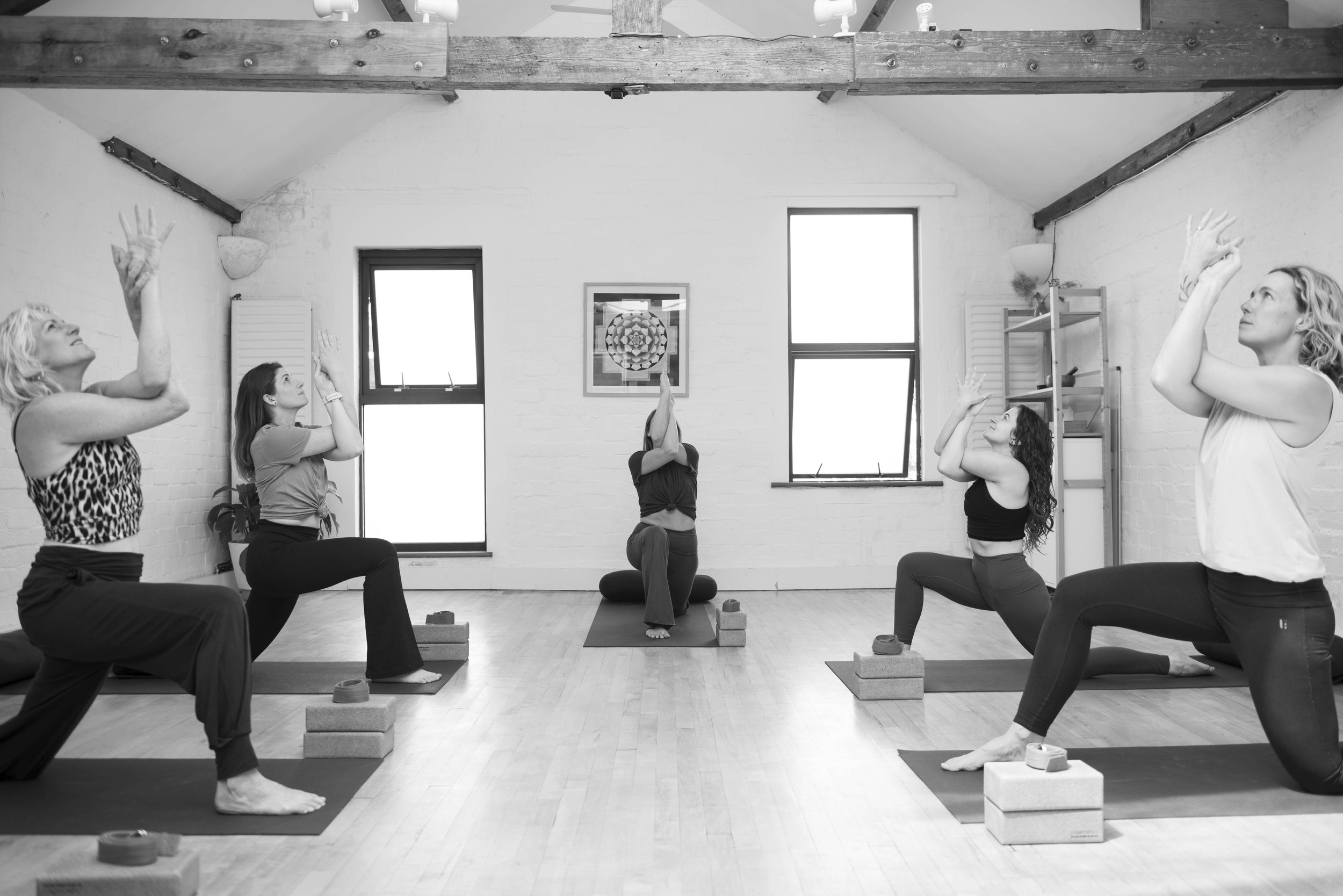
3. Asana The physical postures. Interestingly, Patanjali devotes just three short sutras to asana, describing it simply as a steady, comfortable seat. The enormous physical tradition we know today grew from that seed over many centuries.
4. Pranayama Conscious work with the breath and life force. Profoundly regulating for the nervous system.
5. Pratyahara Turning the senses inward. Learning that you are not at the mercy of every stimulus around you.
6. Dharana Concentration. Deliberately gathering your attention.
7. Dhyana Meditation. Where concentration becomes effortless and sustained.
8. Samadhi Deep absorption. The gradual dissolving of the boundary between the one who is watching and what is being watched.
Here Is Where It Gets Interesting
Most people come to yoga for the asana. That is number three on the list. And that is completely fine, it is a brilliant place to start. But notice what comes first: the Yamas and Niyamas. The ethical and personal practices. The how-we-live stuff.
This is not an accident. Patanjali is telling us something. The inner work and the outer life are not separate. How you are on the mat reflects how you are off it, and working with one changes the other.
This is where yoga becomes transformative in the truest sense. When you take the practice home with you.
The Yamas: Guidelines for How We Live
There are five Yamas -
Ahimsa Non-harm. The commitment to causing as little harm as possible in thought, word, and action. This is considered the foundation that everything else rests on.
Satya Truthfulness. Speaking and living in alignment with what is actually real.
Asteya Non-stealing. Not taking what has not been freely given, which extends well beyond objects to include time, credit, and energy.
Brahmacharya Wise use of energy. Not squandering your vitality on things that deplete rather than nourish you.
Aparigraha Non-grasping. Holding things lightly. Not clinging, not hoarding, not defining yourself by what you own or control.
Of all the Yamas, satya and ahimsa are the ones that tend to land most personally, and the reason is that they are sometimes in real tension with each other.
Think about a moment when someone you love asked for your honest opinion. You knew the truthful answer might sting. You also knew that softening it too much would be its own kind of dishonesty. Sound familiar?
This is yoga as a living practice. Most classical commentators suggest that when truth and non-harm cannot both be fully honoured, you lean toward not causing harm. But this is not a free pass to hide behind niceness. It is an invitation to ask something harder: can I be honest here in a way that comes from genuine care rather than criticism? Can I say what is true without using it as a weapon?
And on the flip side: when I soften something to protect someone else's feelings, am I really protecting them, or am I protecting myself from a difficult conversation?
You do not need to have clean answers to these questions. Sitting with them is the practice. Over time you start to notice that the moments when you speak truth with real warmth are the ones that land most deeply - in your relationships, in your teaching and in how you feel about yourself.
The Yamas are not rules handed down to keep you in line. They are mirrors. Each one reflects something back about who you are when no one is watching, and who you are becoming.
That is what we mean when we say “yoga is transformative”. Not that the practice changes you from the outside. But that it gives you the tools to look clearly, and the courage to act on what you see.
If this resonates with you, this is exactly the kind of depth we explore throughout the 200-hour training.
Philosophy made practical.
Practice made meaningful.